Phu Quoc Low Season Accommodation Deals: Honest Guide for May–October
By Alex Nguyen · Updated August 2026 · 7 min read
- Low season = May through October (southwest monsoon); August–September are the wettest months
- Accommodation prices drop 20–35% from December–February peak rates at most independent properties
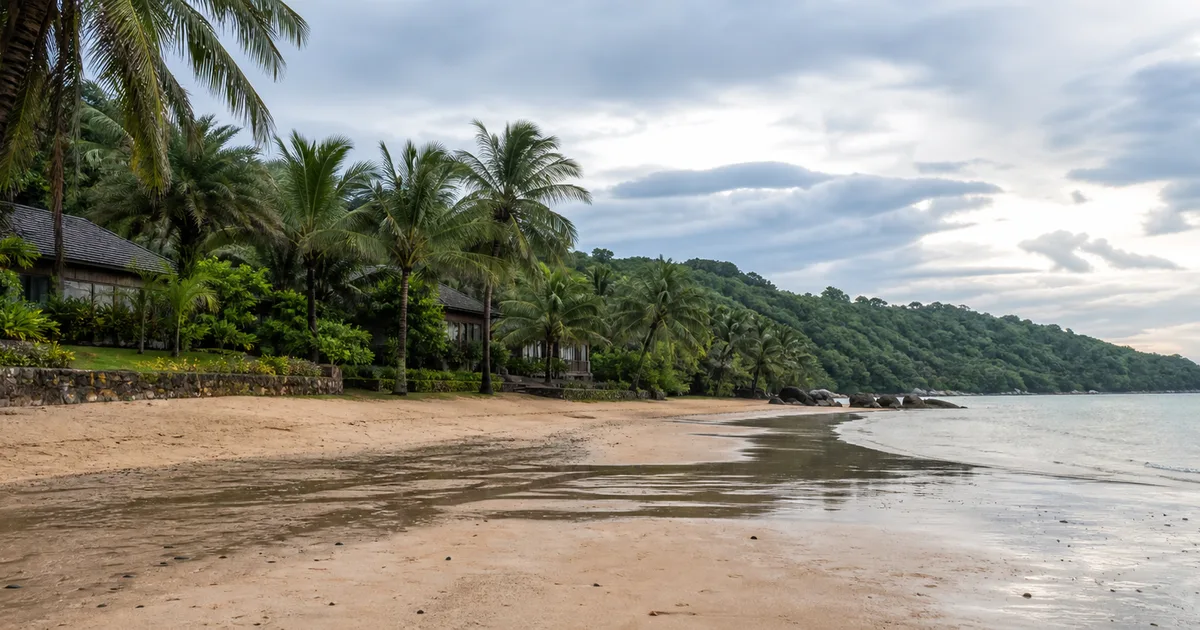
- West coast beaches (Long Beach, Ong Lang) get rough waves June–September — not safe for swimming on windy days
- Rain typically arrives as short afternoon bursts, not all-day drizzle; mornings are usually clear
- Duong Dong town and pool-equipped Ong Lang bungalows are the most practical low-season picks
- Monthly stays are the best deal — landlords negotiate 5–10% below already-lower low-season rates
What Does Phu Quoc's Low Season Actually Look Like?
From May through October, Phu Quoc sits under the southwest monsoon. August and September are the peaks: the island averages 350–400 mm of rain per month in those two months, and the wind picks up from the southwest. May and October are transitions — noticeably wetter than April or November, but short-shower days rather than sustained grey.
The pattern that catches people off guard: mornings are usually fine. Clear sky, manageable humidity, a good 5–6 hours before anything happens weather-wise. Rain tends to build through the afternoon and often dumps heavily between 3 PM and 7 PM. Then it passes. I've been here nine years and the "constant rain" description that circulates online is overstated — what you actually get is weather that reorganises your afternoon.
The bigger practical factor is the sea, not the rain. The southwest monsoon pushes directly against Phu Quoc's western shore. That means Long Beach and Ong Lang can have waves of 1–2 metres on bad days from June through September. The beaches are still there, still walkable — just not swimmable every day.
What the low season does extremely well: the island is quiet. In February, popular stretches of Long Beach have sun loungers shoulder to shoulder. In July, the same stretch has maybe a dozen people. Restaurants take your order faster. Roads are clear. Sunrise at 5:38–5:50 AM in May–August with almost no one else on the beach is genuinely a different experience.
How Much Do Phu Quoc Accommodation Prices Actually Drop?
Most independent bungalows and smaller resorts drop 20–35% from their December–February peak rates during the May–October low season. A bungalow that lists at $65/night in January typically goes for $40–48/night in June or September. Long-term monthly rates barely shift — landlords price those by the year, not the weather.
The bigger international resort brands on Long Beach discount less aggressively — typically 15–20% — because they price floors higher to begin with. The real deals are at independent properties: family-run bungalow clusters, small resorts of 10–20 rooms, and self-catering villas that owners prefer to fill at a lower rate than leave empty.
From our rental mix, some specifics: a 2-bedroom villa on Ong Lang that runs $140/night in January drops to $90–100 in June. A basic bungalow with a/c and garden on Long Beach that goes for $42 in peak season listed at $28 last August. These aren't negotiated rates — just the standard calendar pricing. Direct booking in low season sometimes gets you an extra night free or airport pickup included, because landlords would rather do that than drop the rack rate further.
One thing worth knowing for context: OTA platforms (Booking.com, Airbnb) add their commission on top, typically 15–25% for independent properties in 2025–2026. The gap between listed OTA prices and direct prices is meaningful in low season because the base rate is lower and even a small percentage saving adds up. See our seasonal price overview for a month-by-month breakdown.
Sea Conditions and Swimming in Low Season: What's the Reality?
The west coast beaches — Long Beach and Ong Lang — face the southwest monsoon directly, so waves can be 1–2 metres with strong rip currents from June through September. Swimming is not safe there on rough days. The east coast (Bai Vong area) is calmer in the wet season because the island shields it from the monsoon swell. Bai Sao, in the south, has mixed conditions depending on wind direction.
This doesn't mean the west-coast beaches are useless. On calm days — which do happen, especially in early June and October — Long Beach is swimmable and has almost no one on it. You just can't count on that every day. If regular sea swimming is a hard requirement, the low season on Phu Quoc is the wrong time, or you need to consider the east coast.
The practical solution most of our low-season guests use: book a property with a pool. Ong Lang, in particular, has a high density of bungalows and villas with private or shared pools. During a rough-sea week, the pool becomes the main amenity, and the beach walk in the morning (before the wind picks up) is still there. That's a different experience from a peak-season beach holiday, but it's not a bad one.
Island day trips to the An Thoi archipelago run less reliably — operators cancel when waves exceed 1.5 metres. In May and October, trips usually go 4–5 days out of 7. In July and August, check what the operator's cancellation/refund policy is before booking. Most local ones will reschedule rather than refund, which is fine if you have a flexible itinerary.
Which Areas of Phu Quoc Are Worth Staying In During the Wet Season?
Duong Dong town is the most practical low-season base: infrastructure is unaffected by the weather, food and pharmacy access is easy, and you can day-trip when conditions allow. Rain doesn't change what's available at the VinMart on Nguyen Trung Truc or the night market — it just means you arrive slightly damp. For long stays especially, town-based apartments make more sense in the wet season than a beach bungalow that closes its beachfront access when the swell is up.
Ong Lang properties with private pools hold up well — you're not relying on the sea. Several of the better mid-range resorts there drop to $50–75/night in low season, which is strong value for a private pool, garden, and on-site restaurant. The 10–15 minute ride into Duong Dong keeps you connected to services without giving up the quiet. See our Ong Lang area guide for current listings.
Long Beach is still viable in low season, just don't book a property where beach access is the entire point. The mid-section and southern end of Long Beach have better drainage and more sheltered plots than the exposed northern stretch near Duong Dong. Mid-range resorts with pools on Long Beach drop to $35–80/night, which is competitive. The trade-off is that in a rough week you're paying for location you can't fully use.
Bai Sao in the south is harder to recommend for low-season stays. The beach can be choppy, the choice of accommodation is thin, and the isolation that feels romantic in February feels remote when you're stuck inside waiting out a rainy afternoon with nothing nearby. It works well as a single overnight stop in May or October when conditions are calmer.
How Do Low-Season Rates Compare Across Areas?
The table below shows approximate nightly rates in USD for May–October 2026. Peak-season figures (Dec–Feb) are included for comparison. All prices are for independent and mid-range properties — large resort brands run higher. Check our accommodation budget guide for the full breakdown.
| Area | Peak (Dec–Feb) | Low season (May–Oct) | Typical drop |
|---|---|---|---|
| Long Beach — basic bungalow | $35–55 | $22–38 | 25–35% |
| Long Beach — mid-range resort | $80–140 | $50–95 | 20–30% |
| Ong Lang — bungalow with pool | $75–140 | $48–95 | 25–35% |
| Duong Dong — guesthouse/apartment | $18–45 | $13–32 | 20–30% |
| Ong Lang — 2-bed villa private pool | $120–200 | $80–135 | 25–35% |
These are rack rates. Direct booking via our contact page or WhatsApp often brings an additional 5–8% off, or added perks like airport pickup, especially for stays of 5 nights or more in the low season.
Is Low Season the Best Time for a Long-Term Rental?
For monthly stays, the low season is arguably better value than the dry season. Landlords prefer stable occupancy over leaving a property empty, so monthly rates in May–October are often negotiable 5–10% below the already-lower nightly equivalent. A furnished studio in Duong Dong that runs $380–450/month in peak season can drop to $330–400/month on a monthly agreement signed in July.
The profiles that work well for low-season long stays: digital nomads who are here for reliable WiFi and cheap living (we see a lot of these in June–August, when European summers price them out of other options). Russian-speaking "zimovka" guests who deliberately invert seasons. Families doing a school-year stint who care more about stability and the night market than beach conditions.
One practical note: if you're signing a monthly rental starting in July or August, factor in that some landlords take August off. A few of our smaller villa owners genuinely close for three weeks and visit family. It's not common, but it's worth asking directly before you commit. Our long-term rental guide covers lease structures and what's negotiable.
Apartments in Duong Dong have the most consistent low-season availability — landlords there aren't banking on beach-holiday bookings so they don't take the season off. Studios typically run $300–420/month furnished, 1-bedrooms $400–550. See our apartment listings for current vacancies.
What Should You Actually Look for When Booking Low-Season Accommodation?
Check that the property has good drainage and a covered outdoor space — sitting out after rain is one of the genuine pleasures of the season, and a covered terrace makes that possible. Ask directly whether the property stays open in August. Look for air conditioning (humidity runs 80–90% in August, and it matters for sleep). And a private pool if sea swimming matters to you.
I'd steer away from ground-floor rooms at older properties with minimal drainage. Flooding after heavy rain is rare but happens at a handful of older guesthouses, usually in low-lying spots north of Duong Dong. Upper-floor rooms and newer builds avoid the issue entirely.
Mosquitoes are more active in the wet season. Properties that have screens on windows, mosquito nets over beds, or functioning a/c (which keeps windows closed) are better low-season stays than properties relying on sea breezes for ventilation. It sounds minor until it isn't.
On booking lead time: don't expect the low season to book out — most properties have availability. The exception is the most popular 10–15 bungalow resorts on Ong Lang that have developed a specific low-season following. A few of those fill up 3–4 weeks in advance even in July. If you have a specific property in mind, book it; if you're flexible, you can often arrive and negotiate.
For accommodation types, bungalows with pools are the strongest low-season value — they're priced down relative to peak and you're getting an amenity (private pool) that largely substitutes for the sea. Villas for groups are similarly good value: split a 3-bedroom villa with pool between four people in August and you're paying $25–35/person per night, which beats any guesthouse rate for what you get.
FAQ — Phu Quoc Low Season Accommodation
When exactly is the low season on Phu Quoc?
Phu Quoc's low season runs from May through October — the southwest monsoon period. Rain peaks in August and September, when the island gets 350–400 mm per month on average. May and October are the transition months: shorter showers, less wind, and accommodation prices already 20–30% below dry-season rates.
How much cheaper is accommodation in low season on Phu Quoc?
Most independent bungalows and smaller resorts drop 20–35% from their December–February peak rates during the May–October low season. A bungalow that lists at $65/night in January typically goes for $40–48/night in June or September. Long-term monthly rates barely shift — landlords price those by the year, not the weather.
Is it safe to swim at Phu Quoc beaches during the wet season?
The west coast beaches — Long Beach and Ong Lang — face the southwest monsoon directly, so waves can be 1–2 metres with strong rip currents from June through September. Swimming is not safe there on rough days. The east coast (Bai Vong area) is calmer in the wet season because the island shields it from the monsoon swell. Bai Sao, in the south, has mixed conditions depending on wind direction.
What is the rain actually like in Phu Quoc's wet season?
Typical wet-season rain on Phu Quoc arrives in short, heavy bursts in the late afternoon or evening — often 30–60 minutes, then it stops. Mornings are usually clear and good for touring. The real disruption is wind and sea state rather than rain itself. Sustained all-day drizzle is unusual; the tropical downpour that passes quickly is the norm from May to October.
Which areas of Phu Quoc are best to stay in during the low season?
Duong Dong town is the most practical low-season base: infrastructure is unaffected by the weather, food and pharmacy access is easy, and you can day-trip when conditions allow. Ong Lang properties with private pools hold up well — you're not relying on the sea. Long Beach is still viable, just don't book a property where beach access is the entire point.
Do resorts close during Phu Quoc's low season?
Most independent guesthouses and mid-range bungalow resorts stay open year-round. Some larger international-brand resorts do close for maintenance in August or September — typically for 3–6 weeks. Always confirm directly before booking a stay in August–September, especially at properties under 20 rooms, as small operators sometimes take personal leave in the quietest month.
Can you still do island day trips and snorkelling in low season?
Day trips to the An Thoi archipelago run less frequently in the wet season because sea conditions are less predictable. Operators typically cancel if waves exceed 1.5 metres. In May, June, and early October, trips usually run 4–5 days per week. In July–September, go with an operator who offers weather-dependent refunds — it's standard practice and most local ones do.
Is the low season a good time for a long-term rental or monthly stay?
For monthly stays, the low season is arguably better value than the dry season. Landlords prefer stable occupancy over leaving a property empty, so monthly rates in May–October are often negotiable 5–10% below the already-lower nightly equivalent. A furnished studio in Duong Dong that runs $380–450/month in peak season can drop to $330–400/month on a monthly agreement signed in July.
Are flights to Phu Quoc cheaper in low season?
Generally yes — domestic Vietnamese routes and regional international connections to PQC Airport drop noticeably from May onward. VietJet and Bamboo operate the main domestic routes; international connections from Singapore, Seoul, and regional hubs thin out but don't disappear. Check current fares; they fluctuate week to week rather than following a clean seasonal pattern.
What should I look for when booking low-season accommodation on Phu Quoc?
Check that the property has good drainage and a covered outdoor space — sitting out after rain is one of the pleasures of the season. Ask directly whether the property stays open in August. Look for air conditioning in the room (humidity is high) and a private pool if sea swimming matters to you. Avoid ground-floor rooms at properties with older drainage systems; flooding after heavy rain is rare but real.
Alex Nguyen — Founder, Phu Quoc Rentals
I've been renting accommodation on Phu Quoc since 2018. Before that I managed a guesthouse on Long Beach for three years — which taught me most of what I know about what guests actually need versus what looks good in photos. I live in Duong Dong year-round and I'm reachable on WhatsApp (+84948523139) for any question this guide doesn't answer.
Related Guides
Looking for Low-Season Accommodation Deals?
Tell us your dates, group size, and preferred area — we'll send you available options with direct prices within a few hours. No automated system, no hidden fees.
🔥 11 guests enquired today • ★ 4.9/5 from 312 guests • Free cancellation 7 days before