Phu Quoc Rental Prices by Season — Monthly Overview for 2026
By Alex Nguyen · Updated September 2026 · 7 min read
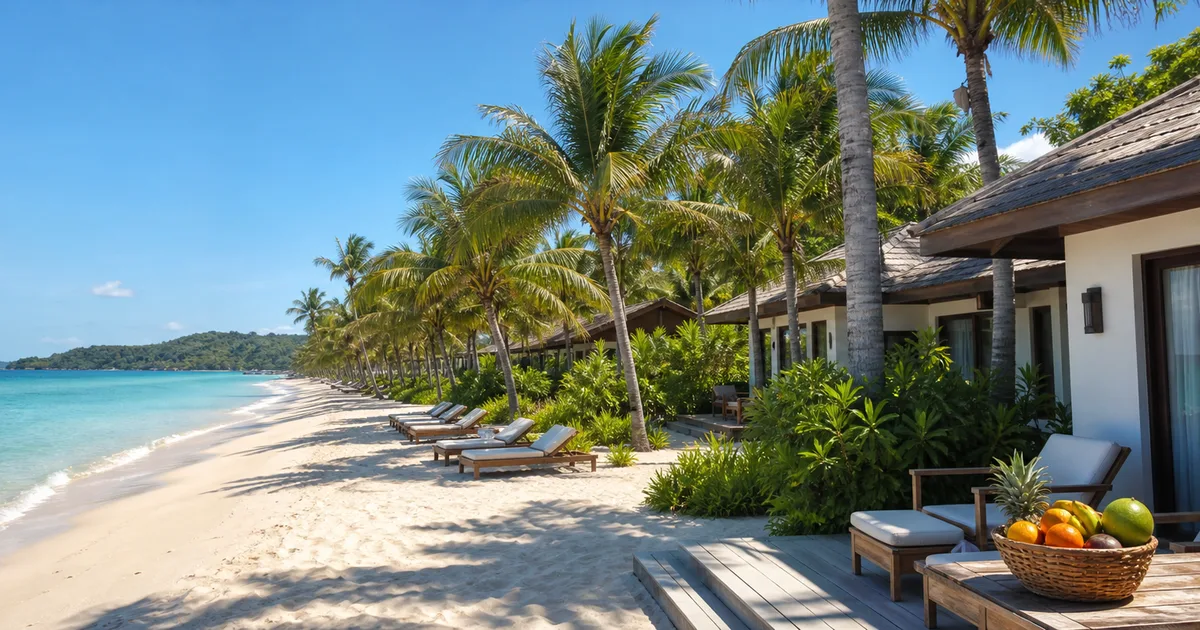
- High season (Dec–Jan): most expensive; bungalow mid-range $80–120/night, villas $150–250+, long-term studios $420–500/month
- Dry shoulder (Nov, Feb–Apr): 10–25% below peak, still good beach conditions
- Wet season (May–Oct): 25–40% below peak; the savings are real, rain is afternoon-only
- Tet week (late Jan/Feb): add 20–40% to January rates — book 6–8 weeks ahead
- Beachfront bungalows have the biggest price swings; town apartments are most stable
- Direct booking saves the OTA commission markup — contact properties before checking platforms
How Do the Two Seasons Actually Affect Rental Prices?
The short version: dry season costs more, wet season costs less. But the spread matters. The difference between the cheapest month (August or September) and the most expensive week (the Tet holiday in late January or February) can be 60–70% on the same bungalow. That is not a rounding error — it is the difference between $50/night and $115/night for an identical room.
The dry season runs from November through April. The northeast monsoon brings clear skies and calm seas to the west coast — where Long Beach and Ong Lang sit — and visitor numbers climb steadily from mid-November. Prices follow occupancy, not the calendar, so November is cheaper than December even though both are technically "dry."
The wet season (May through October) is dominated by the southwest monsoon. The west-coast sea gets rough for swimming and afternoon squalls are regular. That combination clears out most short-stay tourists and pushes operators to discount. The savings are real enough that some guests — particularly longer-stay digital nomads and Russian winter migrants arriving in October to scout — plan specifically around the wet-to-dry transition period for the best rate-to-weather ratio.
One detail people underestimate: there is a mini-peak in February that is not just Tet. Vietnamese domestic travel surges for Tet week, but the February half-term holidays for European school systems (particularly French and Russian) also land in that window. If your dates overlap with either, treat February like January pricing. Check our high season tips guide for availability timing.
What Do Phu Quoc Rental Prices Look Like in High Season?
November is the gentlest entry point into dry season. Seas have calmed after October, the beaches are clean, and the island is quieter than it will be from mid-December. A decent bungalow on Long Beach with a pool sits in the $55–75/night range during November. That same unit in late December often climbs to $90–120/night.
December and January are the most expensive months, full stop. European Christmas travel combines with Russian new year holidays and the peak of Vietnam's domestic beach season. Properties on Long Beach and Ong Lang that I rent out directly regularly fill 3–5 weeks ahead during this period. A solid mid-range bungalow with beach proximity runs $80–120/night. Villas with private pools on Ong Lang start at $150/night and go up from there.
February softens a little after Tet — visitor volume drops about 15–20% in the second half of the month. March and April are what I usually describe as the best months for value if you want dry-season conditions: prices are 15–25% below the December peak, the sea is still calm, and the beaches are not overcrowded. A week in March in a $90/night bungalow from January can often be found for $70–78 direct.
April marks the end of reliable dry conditions. The sea stays calm through most of the month, but afternoon clouds start building and the first tentative rain showers arrive late April. Prices reflect the uncertainty — operators start discounting from mid-April even before the rains commit.
How Low Do Phu Quoc Rental Prices Drop in the Wet Season?
May is the transition month. Some properties drop prices immediately in May; others hold dry-season rates through the first two weeks and then cut in the second half when occupancy falls off. By mid-May, most independent bungalows on Long Beach sit 20–30% below their April rates.
June through August is the core wet season. A bungalow that cost $90/night in January runs $50–58/night. A 2-bedroom villa with pool on Ong Lang might be $120–130/night versus $180–200/night in peak. The discount is consistent across property types, but the absolute saving is bigger on higher-end rentals simply because there is more room to move.
July and August bring the heaviest rain — typically 300–350 mm each month. Rain arrives in bursts. The routine is: clear mornings until around noon or 1 PM, then cloud build-up, an hour or two of solid downpour between 2–5 PM, then it clears again by evening. That pattern is disrupted maybe 4–5 days a month by longer spells. Mornings are still usable beach time. The west-coast sea is rough for swimming, but the east coast near Bai Vong is more sheltered in those months.
September and October are the lowest-price months. Demand drops, properties that are normally full sit at 30–40% occupancy, and direct negotiation often yields discounts of 5–10% beyond the listed wet-season rate. Long-term renters — people staying 3 weeks or more — can sometimes lock in rates 15% below the advertised wet-season price if they book directly and pay upfront. See the low season deals guide for specific strategies.
October starts the swing back. Rain remains but begins to taper. Some dry-season visitors arrive in late October specifically to combine the lower rates with improving conditions. Prices start ticking up around mid-October, and by November 1 most properties have shifted back to their dry-season pricing — at least on paper.
Month-by-Month Phu Quoc Rental Price Reference
The table below shows approximate nightly rates in USD for each month across three accommodation categories. These are real-world ranges from our listings and direct market observation in 2025–2026 — not OTA averages, which can run 15–25% higher due to platform commission being built into displayed prices.
| Month | Season | Bungalow (mid-range) | Villa w/ pool | Studio apartment |
|---|---|---|---|---|
| January | Peak dry | $85–120 | $160–260 | $18–25/night |
| February | Peak / Tet | $80–115 | $150–240 | $17–24/night |
| March | Dry shoulder | $70–95 | $130–200 | $15–20/night |
| April | Late dry | $60–85 | $110–175 | $13–18/night |
| May | Transition | $55–75 | $95–150 | $12–16/night |
| June | Wet | $50–65 | $85–135 | $11–15/night |
| July | Wet (peak rain) | $48–62 | $80–130 | $11–14/night |
| August | Wet (peak rain) | $48–60 | $80–125 | $10–14/night |
| September | Wet (lowest) | $45–58 | $75–120 | $10–13/night |
| October | Wet / tapering | $50–68 | $85–140 | $11–16/night |
| November | Dry shoulder | $58–80 | $110–170 | $13–18/night |
| December | Peak dry | $85–125 | $155–260 | $18–25/night |
Monthly apartment rates (not shown above) are a separate market. A furnished studio in Duong Dong runs roughly $320–380/month in the wet season and $420–500/month during the December–March peak. More detail in our accommodation budget guide and the long-term rental section.
Which Accommodation Type Has the Biggest Seasonal Price Swings?
Beachfront bungalows have the widest seasonal spread — sometimes 50–60% between the December peak and the August trough. The logic is simple: when demand is high, operators on a premium location can charge premium rates; when demand evaporates in the wet season, the same unit needs to attract any guest at all. A bungalow 50 m from the Long Beach shoreline will swing more than a guesthouse room 2 km inland in Duong Dong.
Villas with private pools follow a similar directional pattern but the absolute floor is higher — you won't find a decent private-pool villa on Ong Lang for under $75/night even in September. The seasonal discount is real ($130/night in August versus $200/night in January) but the pool means guests can still use the property productively when the sea is rough, so operators don't need to cut as aggressively to fill bookings.
Town apartments — particularly studios in Duong Dong — are the most stable. The market here is driven by long-stay guests (digital nomads, expats, winter migrants) who book monthly and don't move out because of monsoon rain. Seasonal variance is roughly 15–25% rather than 40–60%. If you're staying 3 weeks or more, this is where the season matters least to your total cost.
Homestays are somewhere in the middle. Family-run operations tend to be less aggressive about raising prices in peak season — they often have regulars who expect a consistent rate — but they also don't have the pricing infrastructure to advertise wet-season discounts cleanly. The best homestay deals often come from repeat contact rather than OTA listings. Our bungalow listings and villa listings show current direct-rate pricing for comparison.
How Do You Get the Best Phu Quoc Rental Rate Whatever the Season?
The single highest-leverage move is booking direct with independent properties rather than through OTA platforms. In 2025–2026, Booking.com charges independent operators 15–25% commission, and Airbnb charges hosts around 15%. Those costs get built into the nightly rate you see listed. A direct WhatsApp message or email to the property cuts out that markup — and most operators will either match the OTA rate or add a small perk (free airport pickup, late checkout) as a thank-you.
Timing matters differently depending on season. For December and January, book 4–8 weeks in advance. Last-minute in peak season on Phu Quoc is genuinely risky — not "hard to find your preferred unit" risky, but "spending your first night in an overpriced place near the port" risky. For wet-season stays, last-minute is fine and sometimes rewarded. I've seen guests arrive in August with no booking and negotiate a rate 10–12% below what was listed that morning.
Stay length is a second lever. Most properties that won't discount a 3-night stay will happily knock 8–12% off a 10-night stay in the same unit. That applies in both seasons — operators value occupancy continuity. We're straightforward about this when guests contact us through our booking page: if your dates are flexible, tell us and we'll tell you if a slightly shifted window saves you money.
One thing that trips people up: comparing the OTA price with a direct-book price and assuming the OTA is cheaper because of promotions. OTA platforms often show loyalty-discount prices that require a membership account — and the discount is off a base price that already includes the commission. Genuine apples-to-apples, direct rates at independent properties on Phu Quoc come out lower more than 80% of the time in my experience managing these units since 2018.
For a full breakdown by budget tier, see the accommodation budget guide. For what to specifically prioritise if you're arriving in the busy months, the high season tips article covers availability tactics in more detail.
FAQ — Phu Quoc Rental Prices and Seasons
When are rental prices highest on Phu Quoc?
December and January are the most expensive months on Phu Quoc. The dry northeast monsoon brings clear skies and calm seas, European and Russian winter arrivals peak, and demand for bungalows and villas pushes nightly rates 30–50% above the shoulder-season average. A mid-range bungalow that costs $55–70 in October can run $80–110 in January.
How much cheaper is Phu Quoc accommodation in the wet season?
Prices in the wet season (May through October) typically run 25–40% below dry-season rates. A bungalow at $80/night in December often drops to $50–55/night in June or September. The savings are real, but check what the property offers during rain: no pool means afternoons trapped inside when the afternoon squalls hit the west coast.
What months are considered shoulder season on Phu Quoc?
November and April are the two shoulder months. November is the dry season's opening — prices are 10–20% below peak and the sea has mostly calmed down after the monsoon. April is the tail-end of dry season: still good beach conditions, fewer school-holiday crowds than February, and you can often negotiate directly with properties for a slight discount on longer stays.
Is it worth visiting Phu Quoc in July or August despite the rain?
July and August have the heaviest rainfall, but rain on Phu Quoc usually arrives in focused afternoon bursts of 1–2 hours rather than all-day grey. Mornings are often clear. Prices are at their lowest — typically 30–40% below peak — and the island has far fewer visitors. Families on European summer holidays still come and report perfectly usable beach mornings. The west-coast sea is rougher, but the east coast (Bai Vong area) is more sheltered in those months.
Do long-term rental prices also go up in high season?
Monthly apartment rates are less volatile than nightly rates, but they do shift. A furnished studio in Duong Dong that rents for $320–380/month in the wet season can be listed at $420–500/month during the December–March peak, especially if demand from 'zimovka' (Russian winter migrants) is high. Signing a 3–6 month contract before November typically locks in a rate closer to the off-season price.
Which type of accommodation has the biggest seasonal price swing?
Beachfront bungalows show the largest gap — sometimes 50–60% between peak (December–January) and trough (August–September). Villas with private pools follow a similar pattern but with a higher floor. Town apartments and homestays in Duong Dong are the most stable, with seasonal variance of roughly 15–25%.
Are prices higher over Tet (Vietnamese New Year)?
Yes. Tet falls in late January or February and is the single busiest domestic travel period in Vietnam. Phu Quoc sees a surge of Vietnamese visitors during this week, and nightly prices at popular Long Beach properties can jump an additional 20–40% above the already-high January baseline. Availability gets tight 6–8 weeks in advance.
When is the best time to book to get the lowest price?
For wet-season stays (May–October), last-minute bookings often work — occupancy is lower and direct contact with a property can yield a 5–10% discount. For dry-season and especially December–February, book 4–8 weeks ahead. Booking direct rather than through OTA platforms saves the commission markup, which independent properties in 2025–2026 typically pass back as a small discount or perk.
Does Phu Quoc have a rainy season with non-stop rain?
Not non-stop. The southwest monsoon (May–October) brings regular afternoon and evening rain, with July and August typically the wettest months averaging 300–350 mm each. Mornings usually start clear. The west coast sea becomes rough for swimming, but the island is not flooded or inaccessible — activities, restaurants, and road travel continue normally.
Alex Nguyen — Founder, Phu Quoc Rentals
I've been renting accommodation on Phu Quoc since 2018. Before that I managed a guesthouse on Long Beach for three years — which taught me most of what I know about what guests actually need versus what looks good in photos. I live in Duong Dong year-round and I'm reachable on WhatsApp (+84948523139) for any question this guide doesn't answer.
Related Guides


Ready to Book Your Phu Quoc Stay?
Tell us your dates, group size, and preferred area — we'll send you available options with direct prices within a few hours. No automated system, no hidden fees.
🔥 11 guests enquired today • ★ 4.9/5 from 312 guests • Free cancellation 7 days before