Phu Quoc Long-Term vs Short-Term Rental — What the Numbers Actually Look Like
By Alex Nguyen · Updated October 2026 · 7 min read
- Monthly rental on Phu Quoc is 40–60% cheaper per night than the same property's nightly rate
- Apartments in Duong Dong — $380–550 USD/month furnished — are the best long-term value on the island
- Short-term makes sense for trips under 14 nights; monthly pricing only pays off if you commit to 28–30 days
- Low season (May–October) is when owners are most willing to negotiate; contact in September for November arrival
- Deposit is typically one month's rent; always get utility billing method confirmed in writing before you sign
- Most long-term inventory on Phu Quoc is not on OTAs — direct contact is the only way to find it
How Big Is the Monthly Discount on Phu Quoc Rentals?
The gap is substantial. A bungalow at Long Beach listed at $45/night adds up to $1,350 if you paid nightly for 30 days. The same property offered on a monthly basis typically runs $600–750 USD — roughly half the price. That's not a marginal difference; it's the kind of saving that changes the economics of a trip.
Apartments show the steepest drop. A furnished studio in Duong Dong that might command $25–30/night on Booking.com rents for $380–500 USD per month when contacted directly. Divided by 30, that's around $13–17/night — less than half the OTA nightly rate. The reason is simple: landlords here would rather have one reliable tenant for three months than manage weekly turnover and OTA commissions that run 15–25%.
Villas are the exception. A 3-bedroom villa on Ong Lang that goes for $150–200/night on short-term might drop to $2,500–3,500 USD/month on a long-term basis — a discount of 40–50%, still meaningful but less dramatic than apartments. Owners of larger villas have higher fixed costs and more OTA demand, so they don't need to discount as aggressively to fill occupancy.
Who Actually Saves Money Renting by the Month?
The people who get the most out of monthly rental are not necessarily the ones you'd expect. It's not just digital nomads with laptops — though they're a large part of our long-term tenant mix. The bigger group, by volume, is families from Russia and South Korea who come for the dry season (November through March) and stay 6–12 weeks. They've done the math: a furnished apartment in Duong Dong at $450/month for two months is $900. The equivalent in nightly guesthouse rates for 60 nights would be $1,200–1,800.
Solo travellers planning to stay 3–6 weeks also do well on monthly rates. One tenant I had last year — a Thai-Vietnamese woman working remotely in IT — rented a studio for five weeks and paid a pro-rated monthly rate. She saved roughly $400 versus the nightly equivalent, and the kitchen meant she wasn't eating out three times a day.
Couples planning a longer honeymoon or anniversary trip sometimes go the bungalow route for a month — pay $700 for a decent Long Beach bungalow with a garden and pool access, versus $1,200–1,500 at nightly rates. That's reasonable. But for couples staying under 14 nights, the monthly rate doesn't make financial sense unless a landlord is offering a specific low-season deal.
Retirees are a growing category. Vietnam's 90-day e-visa (available for most nationalities since August 2023, costing $25 USD at evisa.xuatnhapcanh.gov.vn) means people can now plan a proper extended stay without the old 30-day cap. Two or three months on Phu Quoc, renting an apartment with a motorbike, is genuinely affordable by Western standards. We have a handful of tenants in their 60s who come every dry season.
Long-Term vs Short-Term Rental: Cost Comparison by Property Type
The table below compares typical 2026 rates in USD. Nightly rates are dry-season (November–April) rack rates; monthly rates are direct-contact long-term prices, utilities typically separate.
| Property type | Nightly rate | 30 nights at nightly rate | Monthly (direct) | Saving vs nightly |
|---|---|---|---|---|
| Studio apartment, Duong Dong | $25–30 | $750–900 | $380–500 | ~45–55% |
| 1-bedroom apartment, Duong Dong | $35–45 | $1,050–1,350 | $500–750 | ~40–55% |
| Bungalow, Long Beach | $40–55 | $1,200–1,650 | $700–1,000 | ~40–45% |
| Bungalow with pool, Ong Lang | $70–100 | $2,100–3,000 | $1,200–1,800 | ~40–45% |
| 3-bedroom villa, Ong Lang | $150–200 | $4,500–6,000 | $2,500–3,500 | ~40–45% |
Monthly rates above are direct-contact 2026 estimates; rates change seasonally and by property. See our long-term rental page for current availability, and our full cost guide for more detail on what's included.
What Actually Changes When You Switch to Monthly?
The price drops, obviously. But the experience shifts in ways that aren't always obvious until you've done it.
Utilities move from included to extra. On short-term OTA bookings, electricity is baked into the nightly rate. On monthly contracts, you pay at the government rate — roughly 3,000–4,000 VND per kWh as of 2026. Air conditioning is the main cost driver; run it 8–10 hours a day and expect an electricity bill of $30–60 USD a month on top of rent. Landlords aren't gouging you here — that's the actual grid rate. Water and WiFi are usually included in apartments; confirm in writing.
Daily housekeeping disappears. Monthly tenants get the unit cleaned once a week at most, sometimes less. If you want more frequent service, you negotiate it separately — a local cleaner coming twice a week typically costs 200,000–300,000 VND per visit. That's $8–12 USD. Perfectly reasonable.
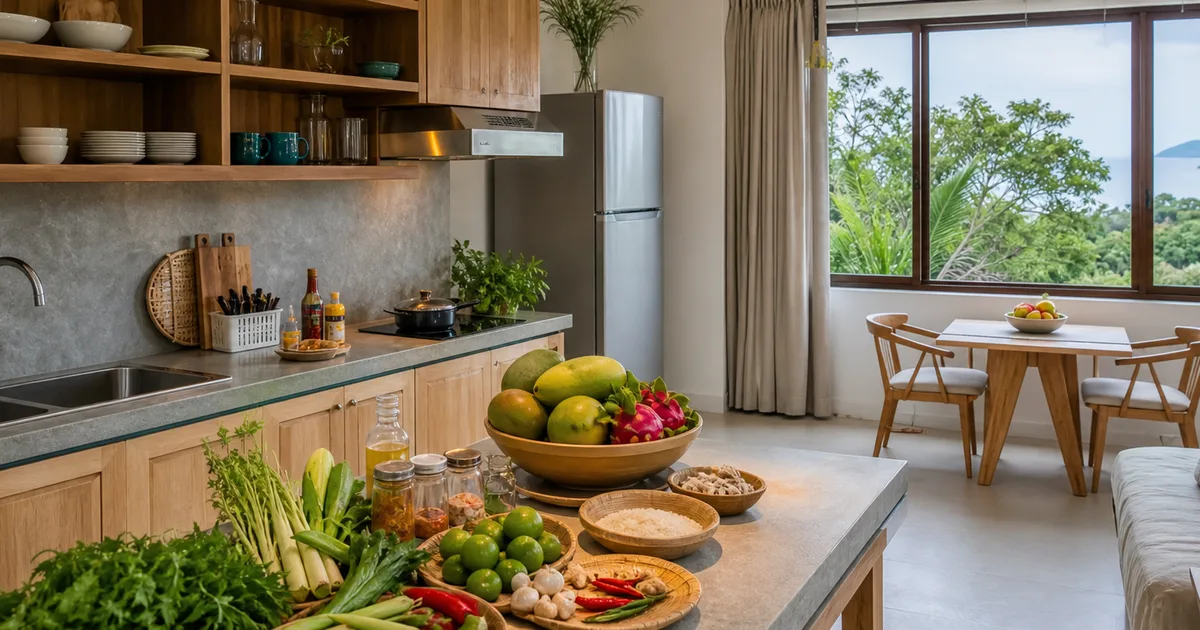
The kitchen goes from optional to useful. Most monthly apartments in Duong Dong have a kitchenette with a two-burner gas hob, a small fridge, and the basics. VinMart on Nguyen Trung Truc is open until 10 PM and has everything you need. A week of groceries for one person runs $25–40 USD depending on how much you cook versus eat out. Over a month, that difference from eating out three times a day can be $300–400.
You get a deposit. Typically one month's rent, paid upfront alongside the first month's payment. Get the landlord to sign something — even a photo of a handwritten note on WhatsApp counts in practice. Document any pre-existing damage with photos on day one and share them immediately. I've seen disputes about a broken fan or a scuffed wall cause more stress than they're worth; five minutes of documentation avoids all of it.
When Does Short-Term Rental Still Make More Sense?
Under 14 nights, short-term is almost always the right call. Monthly pricing is calibrated for 28–30 day commitments. Paying a full month's rent for a 10-night stay doesn't save you anything — you'd be better off on a nightly OTA booking, particularly during peak season (December–February) when you might actually want the flexibility to move properties.
Short-term also makes more sense if your plans are uncertain. Flexibility has real value. If you book a monthly apartment and then decide you want to leave after three weeks, you'll typically lose some or all of the remaining rent. Most landlords here won't prorate a refund for early departure unless you negotiate that specifically upfront. Month-long commitments need to actually be month-long.
And for the higher-end bungalow or resort category — $120+/night — short-term can be worthwhile even for 2–3 weeks if you're prioritising the resort experience: daily housekeeping, a pool with sunbeds, a beach bar, breakfast included. Monthly rates for that calibre of property exist but involve trade-offs (reduced services, different room configurations). For a genuine resort holiday, nightly booking makes sense. Monthly rental is a different product.
One exception worth knowing: during the low season (May–October), some landlords run 10–14 night specials at near-monthly rates to fill vacancy. If you're flexible on timing, late June through September is when you'll find the most room to negotiate on short-to-medium stays. Ask us directly — we know which owners are willing to deal in the off-season. See our self-catering rentals guide for more on what's available when you want a kitchen and more space than a hotel room.
How Do You Actually Find Long-Term Rentals on Phu Quoc?
The honest answer: most long-term rentals on Phu Quoc are not on Airbnb or Booking.com. Landlords with genuinely good apartments at monthly rates don't need OTAs — the fees make no sense for long-term lets, and the OTA platforms aren't designed for monthly tenancy agreements anyway. The inventory you find on OTAs is mostly short-term product that owners are reluctant to give monthly discounts on because they can fill it at full nightly rates from tourists.
The actual routes are: local Facebook groups (search "Phu Quoc long term rental" — there are several active ones where landlords post directly), word of mouth from other expats, and direct contact with local agents or property managers. Our long-term rental page lists what we currently have available with direct prices. If nothing there fits, contact us on WhatsApp (+84948523139) and we'll ask around — after several years here I know which landlords have units coming free and which ones are reliable.
Timing matters. The best units in Duong Dong are snapped up by October for the November–March season. If you want to arrive in November and have your pick of apartments, you need to be contacting landlords in September. Arriving in November without a plan and looking for a good monthly apartment in your first week is doable but stressful — you'll end up in whatever's left, not what you'd have chosen.
Booking direct also means the pricing works for both sides. In 2025–2026, Booking.com takes 15–25% commission from independent properties; Airbnb charges hosts around 15%. Those costs end up in the price you see on the platform. Contacting a landlord directly — especially for a monthly stay — removes that overhead, and most owners will pass some of it back as a lower rate or extras. Not a guarantee, but it's the norm in our experience.
FAQ — Long-Term vs Short-Term Rental on Phu Quoc
How much cheaper is monthly rental on Phu Quoc compared to nightly rates?
Monthly rental on Phu Quoc is typically 40–60% cheaper per night than the same property's nightly rack rate. A bungalow listed at $45/night works out to $1,350 for 30 nights; the same place rented by the month usually runs $550–700 USD. The discount is larger on apartments ($300–500/month vs $25–35/night nightly equivalent) and smaller on villas where owners have less incentive to discount.
What is the minimum stay for long-term rental on Phu Quoc?
Most long-term rates on Phu Quoc kick in at 28–30 days. Some owners use 3 weeks (21 days) as the threshold for a reduced weekly rate, but true monthly pricing — with utilities either included or at cost — generally starts at one calendar month. A few landlords in Duong Dong offer two-week discounts in the low season (May–October), but these are the exception.
Which type of accommodation is best for long-term rental on Phu Quoc?
For stays of one month or more, a furnished apartment in Duong Dong is the most practical and cost-effective option: studios typically run $380–550 USD/month fully furnished, include reliable internet (50–100 Mbps), and put you 10 minutes by motorbike from every part of the island. Bungalows are a reasonable second choice if you want a garden or beach setting; monthly rates on bungalows at Long Beach or Ong Lang usually run $700–1,400 USD depending on quality.
Are utilities included in long-term rental prices on Phu Quoc?
It varies by landlord and property type. Apartments in Duong Dong most commonly charge electricity at the Vietnamese government rate (around 3,000–4,000 VND per kWh as of 2026) on top of the base rent; water and WiFi are often included. Bungalow monthly rates sometimes bundle everything — ask specifically about air conditioning costs, which add up quickly in the tropics. Always confirm in writing before signing.
Can I negotiate long-term rental rates directly with owners on Phu Quoc?
Yes, and it usually works. Most independent property owners on Phu Quoc prefer long-term tenants over constant OTA turnover. If you contact us or a local landlord directly and commit to two or three months upfront, it's reasonable to ask for 5–10% off the advertised monthly price, or for extras like a motorbike included or a free airport pickup. OTA platforms don't carry most long-term inventory anyway — direct contact is the only reliable route.
Is short-term rental better value for stays under two weeks on Phu Quoc?
For stays of 7–14 nights, short-term nightly rates usually make more sense unless you find a landlord willing to offer a weekly discount. Monthly pricing is designed for 28–30 day commitments; paying for a full month when you'll only be there 10 days wastes money. The exception is the low season (May–October): some owners offer 10–14 night rates at near-monthly prices just to avoid vacancy.
Do I need a contract for long-term rental on Phu Quoc?
A written contract is strongly recommended for any rental of 30 days or more. It should cover the monthly rate, utility billing method, deposit amount (typically one month's rent), notice period for ending the stay, and any house rules. In practice, many arrangements between foreigners and local landlords on Phu Quoc are handled with a simple one-page agreement in Vietnamese and English — good enough to resolve misunderstandings without needing a lawyer.
What does a monthly rental apartment look like on Phu Quoc?
Monthly apartments in Duong Dong are typically furnished studios or one-bedroom units in small residential buildings — not resort complexes. Expect a kitchenette or full kitchen, air conditioning in the bedroom, a ceiling fan in the living area, and basic furniture. The buildings are mostly 3–5 storeys, no lift, built in the 2015–2022 range. Views are usually of the street or a courtyard, not the sea. The sea is 10–15 minutes away on a rented motorbike.
Which season is best to lock in a long-term rental deal on Phu Quoc?
The low season (May through October) is the best time to negotiate long-term rates. Occupancy drops, OTA bookings slow, and landlords are more flexible — both on price and on minimum stay length. If you plan to arrive in November for the dry season and want a good monthly rate, contact owners in September or early October; waiting until November means competing with the seasonal influx of Russian and Korean winter visitors who drive demand up sharply.
What is the typical deposit for a monthly rental on Phu Quoc?
The standard deposit for a monthly rental on Phu Quoc is one month's rent, paid upfront along with the first month. Some landlords ask for two months if the stay will be three months or longer. Deposits are returned at the end of the stay minus any damage beyond normal wear — keep photos of any pre-existing damage on day one, and get the landlord to acknowledge them in writing or via WhatsApp message.
Alex Nguyen — Founder, Phu Quoc Rentals
I've been renting accommodation on Phu Quoc since 2018. Before that I managed a guesthouse on Long Beach for three years — which taught me most of what I know about what guests actually need versus what looks good in photos. I live in Duong Dong year-round and I'm reachable on WhatsApp (+84948523139) for any question this guide doesn't answer.
Related Guides

Looking for a Long-Term Rental on Phu Quoc?
Tell us how long you're staying, when you arrive, and what type of place you're after — we'll come back with available options and direct monthly prices, usually within a few hours.
🔥 11 guests enquired today • ★ 4.9/5 from 312 guests • Free cancellation 7 days before